
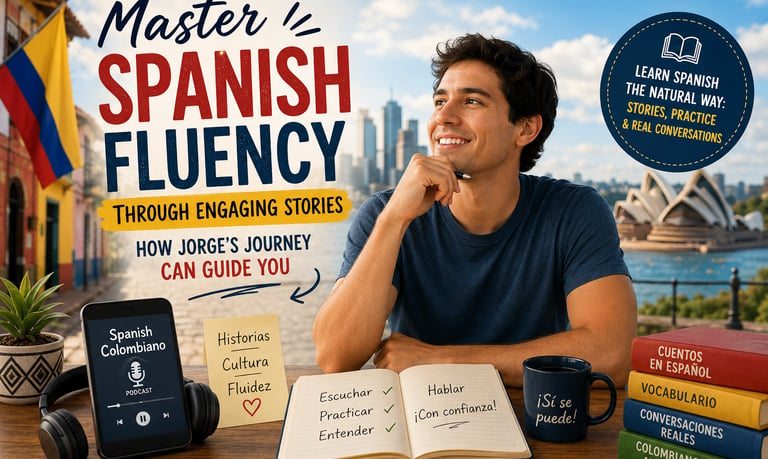
Master Spanish Fluency Through Engaging Stories: How Jorge’s Journey Can Guide You
Discover fluency tips in Spanish through Jorge’s inspiring journey. Learn to enhance your Spanish with stories and active practice.
7/2/20263 min read
Master Spanish Fluency Through Engaging Stories: How Jorge’s Journey Can Guide You
Introduction
Hola, amigos! If you’re learning Spanish and you’re at that “intermediate plateau” where you can read fairly well but struggle to understand native speakers, you’re not alone.
Many learners reach this stage and feel stuck—not because they lack vocabulary, but because real-life Spanish sounds fast, messy, and unpredictable.
This is exactly where storytelling becomes one of the most powerful tools for fluency.
In this article, we’ll explore the journey of Jorge, creator of the Spanish Colombiano method, and how his experience moving from Colombia to Australia led him to discover a better way to learn Spanish—through real stories, active listening, and consistent practice.
Jorge’s Story: From Colombia to Australia
In 2018, Jorge left Colombia and moved to Australia to begin a new chapter of his life. Like many language learners, he quickly discovered that real communication in another language is very different from classroom Spanish or structured learning.
As a civil engineer working on complex projects—ranging from building design to tunnel fire protection systems—Jorge had to constantly adapt, learn new technical vocabulary, and communicate in high-pressure environments.
But the biggest challenge wasn’t technical—it was linguistic.
Even with a solid foundation in English, understanding native speakers in real time was difficult. Conversations moved fast, words blended together, and meaning often got lost.
Over time, this experience led him to an important realization:
Immersion alone is not enough. Progress comes from active engagement with the language.
This insight became the foundation of what would later evolve into his teaching approach through the Spanish Colombiano platform.
The Key Shift: Why Passive Learning Doesn’t Work
One of the biggest misconceptions in language learning is that “being surrounded by the language” automatically leads to fluency.
Jorge’s experience showed otherwise.
You can listen to Spanish all day and still struggle to speak or understand it if you’re not actively interacting with the language.
Real progress happens when you:
Focus your attention on meaning, not just sounds
Repeat and mentally process what you hear
Practice using language in response, not just consumption
Fluency is not passive exposure—it is active training.
What Actually Builds Spanish Fluency
1. Active Listening (Not Background Listening)
Listening to Spanish podcasts or stories is powerful—but only if you engage with them.
Instead of treating audio as background noise, try to:
Focus on key ideas, not every word
Pause and replay difficult sections
Notice expressions used in everyday speech
This trains your brain to recognize patterns in real Spanish conversations.
2. Practice Real Conversations (Even Alone)
One of Jorge’s biggest breakthroughs came from realizing that fluency is built through use, not just understanding.
You don’t always need a partner to practice.
You can:
Narrate your day in Spanish
Answer imaginary questions out loud
Repeat phrases from podcasts in your own voice
The goal is to turn passive knowledge into active speech.
3. Learn Through Stories, Not Isolated Words
Stories are powerful because they give context.
Instead of memorizing random vocabulary, you see how words behave inside real situations—emotion, conflict, humor, and everyday life.
This is the core idea behind the Spanish Colombiano method: learning Spanish through engaging, real-life storytelling.
Key Spanish Vocabulary From This Lesson
Inmigrante
Persona que llega a un país distinto del propio para vivir allí.
Example: Jorge es un inmigrante colombiano en Australia.
Curva de aprendizaje
El proceso de aprender algo nuevo, especialmente si es difícil al principio.
Example: Adaptarse al inglés fue una gran curva de aprendizaje.
Fluidez
Capacidad de hablar un idioma con facilidad y naturalidad.
Example: La fluidez se mejora con práctica constante.
Conversación real
Intercambio natural de ideas entre personas, sin guión.
Example: Las conversaciones reales mejoran la comprensión auditiva.
Why Stories Improve Your Spanish Faster
Listening to real stories—like those shared in the Spanish Colombiano podcast—helps you develop multiple skills at once:
You train your ear to understand native speech
You learn vocabulary in real context
You improve pronunciation naturally
You absorb grammar without memorizing rules
Most importantly, you start thinking in Spanish instead of translating.
Conclusion
Fluency in Spanish is not about perfection. It’s about familiarity, repetition, and confidence.
Jorge’s journey shows that the key shift happens when you stop studying Spanish as isolated rules and start experiencing it as real communication.
Stories are not just entertainment—they are training for your brain.
If you want to improve your Spanish through real, engaging stories, you can join the Spanish Colombiano Academy.
Inside, you’ll find:
Podcast episodes designed for learners
Full transcripts in Spanish
English translations
Vocabulary breakdowns
Listening and comprehension activities
A step-by-step method to train your ear and speak with confidence
Start learning Spanish the way your brain actually understands language: through stories, context, and real communication.
Privacy Policy Terms and Conditions
Affiliate Disclaimer Resources Blog
© 2026 Spanish Colombiano. All Right Reserved